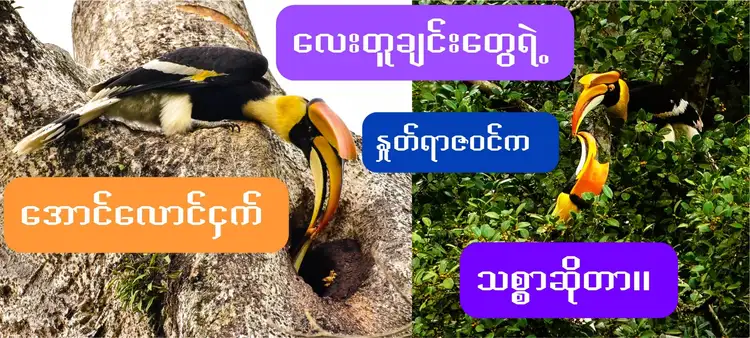
The Letu Chin’s Oral Tradition about the Loyalty of the Great Hornbill
The Great Hornbill is a national symbol bird for the entire Chin nation. The Chin people take great pride in its loyalty. However, the author does not yet know why other Chin tribes consider it loyal. Here, I will share the story of the Great Hornbill's loyalty from the oral tradition of the Letu Chin.
According to the oral tradition of the Letu Chin, Great Hornbills hollow out living, tall, old perennial trees to lay and incubate their eggs. From the nesting period until the chicks hatch, the male must forage and feed the female. They leave an opening just wide enough for her beak to receive food. When the chicks hatch, the male continues to forage for both the mother and the offspring. The mother must remain inside from the moment she begins incubating her eggs until she sheds her wing feathers and finally emerges from the tree hollow together with her chicks. During this period, the male strictly does not eat until his mate is completely full. This is their natural law; the male only eats after the female's hunger is satisfied.
One day, the male was extremely hungry, so he went to a wilderness near a waterfall and ate a single mouthful of food on his own. He assumed that since the roaring waterfall was so loud, his wife would not hear or know about it. However, contrary to his expectations, his wife heard the sound of him swallowing the food. Because of this, the female refused to eat any of the food he brought back and starved herself to death. According to Letu oral tradition, it is because of this tragic story that the Great Hornbill is recognized as a symbol of loyalty. Nevertheless, the actual national symbol bird of the Letu Chin is the Greater Racket-tailed Drongo (Lin-mhee-swe / Nghet-taw / Nghet-min).
Between the Saenuu (Ten) Mountain Range and Lontee (Nine) Mountain Range where the author lives, Great Hornbills are a species of large birds that typically roam either as a breeding pair (male and female) or in small groups of at most three. There are also Oriental Pie Hornbills (Auk-chin) that look quite similar but roam in larger flocks of 10 to 15. These species are smaller. The large Great Hornbill with a double-pointed casque is called Koksi, while the smaller hornbill without a split casque is called Kokkek.
Great Hornbills nest and lay eggs only by hollowing out tall, ancient perennial trees. They typically hatch a maximum of one to two chicks. The mother must remain inside from the time she incubates her eggs until the chicks' feathers are reasonably developed. The male is tasked with providing food; when the chicks hatch, he must forage for the entire family—such is a father's duty. Because of this nesting habit, the female becomes sealed inside the tree. During this incubation period, whether due to nature or perhaps the internal temperature, she sheds all her wing feathers. Her feathers eventually grow back alongside her growing chicks. Wikiwand (formerly Wikipedia) also confirms these facts, stating that the female Great Hornbill remains inside the tree hollow for 38 to 40 days. An opening just large enough for the beak to receive food is left clear. When this period is complete, the mother breaks down the mud plaster wall and emerges. It is said that about two weeks/months later, her chicks follow her outside.
The Great Hornbill is a species belonging to the hornbill family, characterized by its large casque. It can only be found in the Indian subcontinent and Southeast Asia. The government of Kerala, a state in southern India, has officially declared it the state bird of Kerala.
Note: This article was revisited on August 30, 2025.
Photos credited to Wikiwand and the original uploaders.